

Classic Car Restoration for Beginners Review: Your First Project from Barn to Road
Every classic car enthusiast has pictured it: a tired old coupe rolled out of a barn, and months later the same car idling in the driveway, gleaming and ready for its first drive. The gap between those two images is where most first projects stall — rarely for lack of passion, almost always for lack of a plan. Classic Car Restoration for Beginners: Your First Project from Barn to Road by ChatVariety Team is built to close that gap.
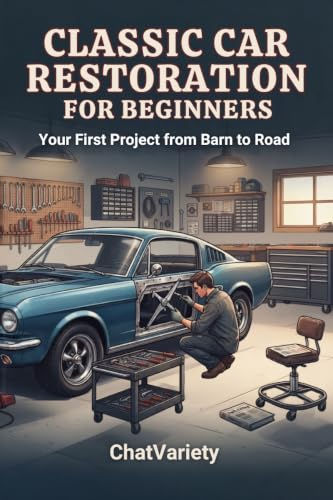
If you've been scrolling the classifieds for a project car — or you already have one hiding under a tarp — this opening title in the Classic Car Restoration Series is written for exactly where you are right now.
What this book is about
The subtitle says it plainly: your first project, from barn to road. Rather than diving deep into a single specialist skill, a beginner's restoration guide is about the whole journey and the order you tackle it in. A first restoration has to cover this ground:
Choosing the right project car — why the cheapest car is rarely the cheapest restoration, and why rust, missing trim and parts availability matter more than the asking price.
Planning and budgeting — deciding between a driver-quality refresh and a full nut-and-bolt restoration, and setting a realistic budget and timeline before the first bolt comes out.
Tools and workspace — what a home garage really needs for a first project, and what is smarter to rent, borrow or send out to a specialist.
Disassembly and documentation — photographing, bagging and labeling parts so the car can actually go back together months later.
The core systems — brakes, fuel, cooling, electrics, body and engine, and which jobs a beginner can tackle versus which deserve a pro.
Getting it road-worthy — the safety checks, shakedown drives and paperwork that turn a project back into a car you can use.
The value of a book like this is the roadmap: always knowing what comes next, so your first project keeps moving instead of turning into a garage full of parts.
Why it stands out
It starts at the very beginning. Many restoration resources assume you can already weld, rebuild a carburetor or lay down paint. A guide written specifically for beginners respects the fact that your first project is also your first education.
It covers the whole project, not one job. Most failed restorations don't fail at a single repair — they fail from poor sequencing, runaway budgets and lost momentum. A barn-to-road perspective tackles the problem where it really lives.
It's the front door to a full series. When you're ready to go deeper, the Classic Car Restoration Series continues into bodywork and paint, engine rebuilding, wiring, restomods and collector-car investing, so you can grow skill by skill.
It costs less than a single part. At US$2.99 for Kindle and US$9.99 for the paperback at the time of writing, it's cheaper than a gasket set — and one avoided mistake on a project car can save many times that.
Who should read it
First-time restorers shopping for, or about to start, their first classic car project.
Enthusiasts who love old cars and want to understand what a restoration really involves before spending serious money.
Parents and kids, or groups of friends, planning a shared garage project.
Owners of an inherited or long-stored car who want to bring it back to the road.
Seasoned restorers with several cars behind them may get more from the series' specialist titles, such as Vintage Engine Rebuilding or Classic Car Bodywork and Paint.
Kindle or paperback?
Kindle (US$2.99 at the time of writing): instant download, searchable text and easy reading on a phone or tablet while you hunt for the right project car.
Paperback (US$9.99 at the time of writing): a garage-friendly reference you can mark up, flag and keep on the workbench — greasy fingerprints and all.
Many readers start on Kindle while planning and pick up the paperback once the car is in the garage. It also makes a thoughtful gift for anyone who has ever said, "One day I'll restore an old car."
More from the Classic Car Restoration Series
Once your project is underway, these companion titles take each stage further:
Barn Find Hunting — finding, valuing and reviving forgotten cars, ideal before you buy your project.
Classic Car Bodywork and Paint — panel repair, prep and spray techniques for when the body stage arrives.
Vintage Engine Rebuilding — from teardown to first start, for the heart of your classic.
FAQ
Is Classic Car Restoration for Beginners suitable if I've never worked on a car?
Yes. As the title says, it's aimed at people starting their first project, and it's the natural entry point to the Classic Car Restoration Series before the more specialized volumes on bodywork, engines and wiring.
What is the hardest part of a first classic car restoration?
For most beginners it isn't one repair but staying organized and on budget. Underestimating rust, losing track of parts during disassembly and letting the scope grow are the classic reasons projects stall. Planning before you buy and documenting as you go prevents most of these problems.
Should I buy the Kindle or the paperback edition?
Kindle (US$2.99 at the time of writing) is best for instant access and reading anywhere. The paperback (US$9.99 at the time of writing) suits a workbench reference or a gift. Both are available on Amazon.
Final verdict
A classic car restoration is one of the most rewarding projects an enthusiast can take on — and one of the easiest to get lost in. The difference between a car that drives and a car that sits in pieces usually comes down to a clear plan at the start.
Classic Car Restoration for Beginners: Your First Project from Barn to Road gives first-time restorers that plan: a beginner-focused roadmap from choosing the car to driving it home. If your dream project is still a daydream — or a tarp-covered shape in the garage — this is an affordable, low-risk first step.


Comments