

The Collector Car Investment Guide Review: How to Buy, Document and Sell Classic Cars Wisely
Classic cars are one of the few investments you can drive on a Sunday morning — and one of the easiest to overpay for. Auction headlines make it look simple, but the real money is made or lost in the details: the inspection you skipped, the paperwork nobody kept, the sale you rushed. The Collector Car Investment Guide by ChatVariety Team, part of the Classic Car Restoration Series, is built around exactly those three moments: buying, documenting and selling a classic.
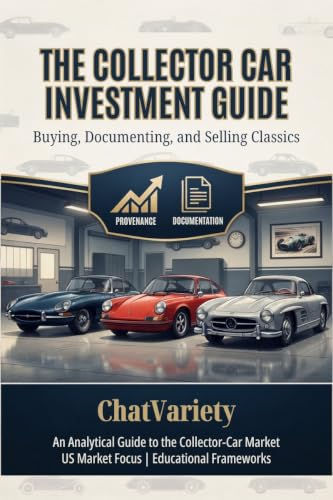
What this book is about
As its subtitle promises, the book follows the full ownership cycle of a collector car from the point of view of someone who wants their passion to hold — and ideally grow — its value. It rests on three pillars:
Buying: how to research a model's market, tell a genuine survivor or correct restoration apart from a shiny quick flip, and why a pre-purchase inspection by a marque specialist is the cheapest insurance in the hobby.
Documenting: why build sheets, original titles, service receipts, restoration photos and ownership history can move a car's value as much as its paint does — and why that paper trail needs to be organised long before you sell.
Selling: the trade-offs between auctions, consignment dealers and private sales, how presentation and timing shape the final number, and what serious buyers expect to see before they bid.
The value of a guide like this lies in method rather than hot tips. Market prices change constantly, but a disciplined way of evaluating, recording and presenting a car works for a weekend roadster and a blue-chip collectible alike.
Why it stands out
Most classic car content falls into two camps: restoration how-tos that ignore money, and market reports that ignore the car. This guide deliberately sits between them. It treats a classic as both a machine and an asset, so the questions it raises are the ones that matter to your wallet: Is this the right car at the right price? Will the work I do add value or simply cost money? How do I prove what I own?
It also takes the less glamorous side of ownership seriously. Storage, agreed-value insurance, ongoing maintenance and selling fees all eat into returns, and any honest look at collector cars as investments has to put those costs on the table. That makes this book a sensible reality check before you commit serious money to a dream car.
Who should read it
First-time classic buyers who want a framework before attending their first auction or answering a classified ad.
Enthusiasts who already own a classic and want to protect its value with better records.
Owners preparing to sell who want to present the car properly and choose the right sales channel.
Readers considering collector cars as an alternative asset alongside more traditional investments.
Restorers and hobby mechanics who want their work to show up in the final sale price.
Kindle or paperback?
Kindle eBook (US$2.99 at the time of writing): instant delivery and fully searchable on your phone — handy to pull up while you walk an auction lot or check a seller's paperwork.
Paperback (US$9.99 at the time of writing): easy to annotate and flag, and a natural companion to keep in the garage alongside your car's documentation binder.
More from the Classic Car Restoration Series
If your investment is about to become a hands-on project, these companion titles pair naturally with this guide:
Classic Car Restoration for Beginners – your first project, from barn to road.
Barn Find Hunting – finding, valuing and reviving forgotten cars.
Modern Classics – restoring 1990s Japanese performance icons, a segment drawing growing collector interest.
FAQ
Is this book financial advice?
No. It is an educational guide to the buying, documentation and selling process. Collector car values can fall as well as rise, so use it to ask better questions and consult qualified professionals before major financial decisions.
Do I need mechanical experience to benefit from it?
No. The focus is on decisions — what to buy, what to record and how to sell — rather than wrenching, so it suits investors and enthusiasts alike. Hands-on readers can pair it with the restoration titles in the same series.
Kindle or paperback — which should I choose?
Choose Kindle (US$2.99 at the time of writing) for instant, searchable reference on the go, or the paperback (US$9.99 at the time of writing) if you like to mark up pages and keep the book with your car's records.
Final verdict
If you are about to buy your first classic, or you already own one and want it to be worth more when the day comes to sell, The Collector Car Investment Guide is an inexpensive way to approach the hobby with clearer eyes. A single avoided mistake — a skipped inspection, a missing title, a rushed sale — can cost far more than the book itself. For anyone who loves classic cars and wants to treat them as serious assets, it is an easy recommendation.


Comments